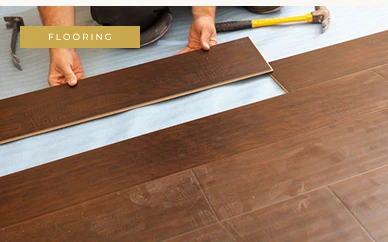
Changing the floor is the single biggest visual change you can make to a Dubai home, and the one where the cheapest quotation most often turns into the most expensive job. The reason is almost always the same: the subfloor.
This article covers the four options worth considering, then the part that decides whether any of them lasts.
Engineered wood and parquet
A real hardwood wear layer bonded to a plywood or HDF core. It looks and feels like solid wood, can be sanded and refinished once or twice, and adds more warmth to a room than any other option.
It is not for wet areas. Standing water will damage it, so kitchens, bathrooms, laundry rooms and balconies are out. In a Dubai villa, the sensible pattern is engineered wood or parquet in the living rooms, majlis and bedrooms, and a water-resistant floor everywhere else.
Herringbone and chevron parquet are the formats that make a hallway or a living room look considered rather than simply covered. They need a flat subfloor more than any other format, because the pattern shows every deviation.
SPC (stone polymer composite)
A rigid-core vinyl plank with a stone-powder core. It is fully waterproof, dimensionally stable in heat, dent-resistant and the most practical floor available for this climate.
It handles kitchens, bathrooms, balconies, villa ground floors, offices and rental apartments without argument. A good SPC with a 0.5 mm wear layer and a realistic print is convincing underfoot; a cheap one with a thin wear layer will show scuffs within a year, and that difference is not visible in a showroom sample.
For most Dubai homes, SPC is the floor we recommend unless there is a specific reason to use wood.
LVT (luxury vinyl tile)
Flexible vinyl planks or tiles, usually glued down. Thinner than SPC, quieter, and available in the widest range of stone and wood effects. Glued LVT is also the easiest option where floor height is tight, such as under a door that cannot be trimmed.
It needs a near-perfect subfloor, because being flexible it telegraphs every bump. Waterproof, and good in offices, clinics, retail and apartments.
Laminate
A photographic layer over an HDF core. The cheapest of the four, and it has improved, but the core is wood-based: a leak or a mopping accident swells the joints and that damage is permanent.
Reasonable in a dry bedroom on a tight budget. We do not recommend it on a villa ground floor or anywhere near water in Dubai, where the cost difference to SPC is small and the risk difference is large.
Carpet tiles and broadloom
Worth a mention for offices and bedrooms. Carpet tiles are hard-wearing, replaceable tile by tile, and the standard choice for an office fit-out. For bedrooms, broadloom carpet over underlay does more for warmth and acoustics than any hard floor; see carpets and rugs.
The subfloor: where jobs go wrong
Almost every flooring complaint we are called about comes down to one of these.
The floor was not level. Planks over an uneven base flex. Flexing opens the joints, creaks, and eventually breaks the locking profile. A self-levelling screed where it is needed is not an upsell; it is the job.
Moisture was not checked. A new or recently screeded slab holds moisture, and laying over it traps that moisture under the floor. A moisture reading before laying takes minutes.
No expansion gap. Every floating floor expands. Laid tight to the wall with no gap under the skirting, it lifts in the middle in summer. This is the most common fault we see in Dubai, because the temperature swing between an air-conditioned room and a closed-up villa in August is large.
The wrong underlay, or none. Underlay carries acoustics, comfort and part of the moisture barrier. Skipping it to save a small amount per square metre is a false economy in an apartment with neighbours below.
Laying over existing tiles
In most Dubai apartments and villas, yes, and it is usually the right call. Removing tile is dusty, slow, expensive and can damage the screed below.
What has to happen first: check for loose or drummy tiles and refix them, check the overall level across the room, fill the grout lines and level where needed, then lay. The only reasons to remove instead are a floor height that cannot be raised, or tiles that are failing across the whole area.
Skirting, thresholds and the finish
A floor is judged at its edges. New or refitted skirting hides the expansion gap and makes the job look built rather than laid. Door thresholds matter where two floor types meet, and where a floor meets a tiled wet area. We quote skirting, beading and thresholds with the floor rather than leaving them as a surprise.
A typical two-bedroom apartment is laid in one to two days once the subfloor is ready, and furniture moving can be included. The full specification is on our flooring page, and we measure on site anywhere in Dubai as part of the quotation.
Nine out of ten flooring complaints are not about the plank. They are about the floor underneath it.