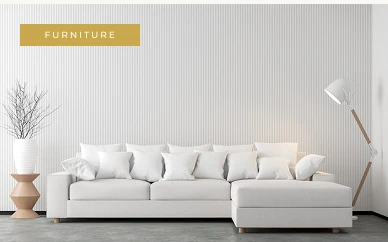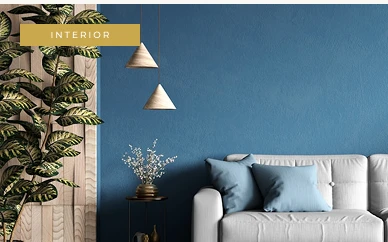
Most living rooms in Dubai are not difficult to furnish because of taste. They are difficult because of proportion. Apartment living rooms are long and narrow with one glazed wall. Villa living rooms are generous but have doors on three sides and a staircase cutting into the plan. In both cases, furniture bought off a showroom floor is the wrong size, and the room never quite settles.
This is what we work through with clients every week at our Al Khawaneej factory, and the order below is the order that works.
Start with the measurements, not the sofa
Before anything is chosen, write down four numbers: the length of the longest usable wall, the width of the room at its narrowest point, the distance from the wall to the nearest door swing, and the ceiling height. Those four numbers decide more than any mood board.
A few rules we apply:
Leave 80 to 90 cm of walking space in front of a sofa. Less than that and the room feels tight even when it looks right in a plan.
Keep 2.2 to 2.5 metres between facing seats. Further apart and conversation stops working; closer and the coffee table has nowhere to go.
In an apartment under 3.5 metres wide, a single long sofa with two armchairs almost always beats an L-shape. The L-shape eats the circulation space.
Decide the seating layout before the style
There are really only four layouts that work in a Dubai living room, and the room usually picks one for you.
One long run along the window wall. Best for narrow apartments. Keeps the floor clear, and the view stays open.
Facing sofas. Best for square villa living rooms, and the layout closest to how families actually sit together.
L-shape into the corner. Best where one corner is dead space anyway. Needs at least 3.8 metres of clear width.
Continuous bench along two or three walls. This is majlis seating, and in a room used for large gatherings it seats twice as many people as loose furniture in the same area. We cover the detail of this in our majlis seating work.
Fabric: the choice that decides how the room ages
Fabric is where most of the regret happens, and the reason is almost always the same: a beautiful fabric chosen for how it looks in a showroom, used in a room where the family actually lives.
Three questions settle it. Will children or pets sit on it? Does afternoon sun reach the seat? Will the covers need cleaning more than once a year?
If the answer to any of those is yes, look at a tight performance weave or a high rub-count velvet rather than a loose linen. Linen is beautiful and it creases and marks, which is fine on an occasional chair and painful on the sofa everyone uses. Sun is the harsher problem in Dubai: anything in direct afternoon light will fade, so pick a solution-dyed or sun-tolerant fabric for that seat and keep the delicate one for the shaded side of the room.
We hold over 200 fabrics and the useful part of a showroom visit is not browsing them. It is taking three or four samples home and looking at them in your own light at the time of day you use the room.
Curtains do more work in Dubai than anywhere else
Curtains here are not decoration. They are the difference between a comfortable room and a hot one, and between sleeping and not sleeping.
For a living room with full-height glazing, the arrangement that works is a sheer behind and a heavier curtain in front, both on a ceiling-fixed track rather than a pole. The sheer gives you daytime privacy without closing the room off; the outer curtain cuts the heat and the glare. Fixing at the ceiling, not above the window, makes the room look taller and stops the light leaking over the top.
Where a full curtain is too heavy, which is common in kitchens and smaller windows, a Roman blind gives you the soft fold of a curtain in a much smaller stack. The full range of headings and linings is set out on our curtains and blinds page.
Flooring and the layers above it
Most Dubai homes come with tile or marble, which is practical and acoustically hard. A room with bare tile, glass and plaster echoes, and the echo is why some living rooms feel uncomfortable without anyone being able to say why.
A rug is the cheapest fix. Size it so the front legs of all the seating sit on it; a rug that floats in the middle of the floor makes the room look smaller, not bigger. If you want to change the floor itself, engineered wood or parquet warms a living room considerably, and SPC or LVT is the sensible choice anywhere water reaches. We go into the comparison on our flooring page.
Above the floor, a panelled or papered feature wall behind the main sofa does more for a living room than any amount of accessories, because it gives the seating something to sit against. Both wall panelling and wallpaper work for this; panelling reads as more permanent, wallpaper is faster and easier to change.
The order to do it in
Measure the room. Fix the seating layout. Choose the sofa size and fabric. Then curtains, then rug or flooring, then the wall behind the sofa, then lighting and accessories. Working in that order means nothing has to be bought twice.
If you would rather not work it out on paper, we will come to the room. A site measurement anywhere in Dubai is included with your quotation, and we will set out the seating plan with you before anything is made. Send your room photos and measurements through our quotation form or on WhatsApp and we will come back with options.
Measure the room before you fall in love with a sofa. Everything else follows from the measurements.