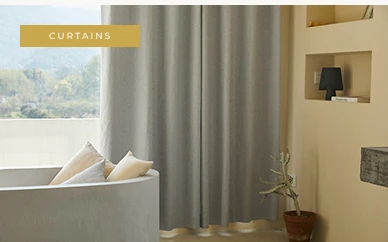
The short answer: offices usually go to blinds, hotels usually go to curtains, and the deciding factors are rarely aesthetic.
This is written for the people who sign off the specification — project managers, FF&E consultants, facilities teams and hotel owners — rather than for a homeowner choosing a fabric.
Fire certification, blackout performance, cleaning cycles and replacement intervals decide more UAE fit-outs than any mood board does.
Start with the requirements, not the product
Before comparing curtains and blinds, four questions usually settle the answer.
Is there a fire certification requirement? In UAE hotels, hospitals and most commercial buildings the answer is yes, and it governs everything downstream.
How dark does the room need to go? A guest expecting to sleep after a night flight has a different standard than an open-plan office.
Who cleans it, and how often? The maintenance cycle is a recurring cost that dwarfs the one-off difference in purchase price.
What does the window actually look like? Floor-to-ceiling glazing, a curved bay and a small punched window do not have the same answer.
Fire rating comes first
For any public or commercial interior in the UAE, window fabrics are expected to meet flame-retardant standards, and the relevant civil defence authority will ask for the certificate.
Inherently flame-retardant (IFR) fabric carries the property in the fibre itself. It survives washing and never needs re-treating. More expensive up front, cheaper across the life of the installation.
Treated fabric has a coating applied. Cheaper initially, but the treatment degrades with cleaning and must be reapplied, which means the certificate has a shelf life.
For a hotel, IFR is almost always the right call. A treated fabric that loses its rating after the third wash becomes a compliance problem at the worst possible time. Keep the test certificates with the O&M documentation.
Hotels: why curtains usually win
Blackout is a guest-satisfaction metric. Light leaking into a guest room at 5:30am produces complaints and poor reviews, and it is one of the few interior details guests mention by name. Curtains with a proper blackout lining, a ceiling-recessed track, generous centre overlap and a return to the wall at both ends can get a room genuinely dark. Blinds struggle here: a roller or Venetian needs a gap at the sides to operate, and that gap glows. Side channels help and are worth specifying, but they add cost and complexity.
Acoustics and perceived quality. Soft furnishing absorbs sound. In a room with hard flooring and glazing, a lined curtain takes the edge off reverberation. It also reads as more expensive, which matters in a sector where the room is the product.
Maintenance is predictable. Curtains come down, go out for cleaning, come back. It is a known cycle with a known cost, and it can be scheduled floor by floor during low season.
The usual hotel specification: double track with sheer in front and blackout-lined curtain behind; IFR fabric with current certification; ceiling-recessed track with a pelmet or shadow gap; centre overlap arms and wall returns; motorisation in suites and on tall glazing; and one spare set per room type held in stores for immediate swap-out.
Offices: why blinds usually win
The problem is glare, not darkness. Office complaints are about screen reflection and afternoon heat on the west side of the floor, not about the room being too bright to sleep. A light-filtering roller or a Venetian handles this precisely.
Blinds suit the architecture. Modern offices have continuous glazing and mullions at fixed centres. Blinds divide neatly into bays, stack into almost no space, and keep the facade reading as glass. Curtains across a thirty-metre run create a stack problem at every return.
Cleaning is in place. Blinds are wiped, vacuumed or spot-cleaned without being removed, which suits a floor that cannot be taken out of service.
The usual office specification: light-filtering roller blinds on general floor plates with a tighter weave on west and south elevations; blackout roller with side channels in boardrooms and any room with projection; aluminium Venetians where individual control matters; linked or motorised systems on high-level glazing; and wipe-clean finishes in clinics and labs.
Where the answer flips
The rules above are defaults, not laws. Hotel lobbies, restaurants and ballrooms want curtains for scale and acoustics. Hotel bathrooms want a blind, for moisture. Executive offices and boardrooms often want both — sheer for day, blackout for presentations. Serviced apartments want curtains, for a residential feel and for sleeping. Co-working spaces want blinds, for durability and simple replacement. Clinics want wipe-clean blinds, for hygiene protocol. Mosques and prayer rooms want curtains, for acoustics and appearance. Staff housing wants blinds, for low maintenance and low cost per unit.
Cost: look at five years, not at the quotation
Comparing purchase prices alone is the most common specification error. A fair comparison includes purchase and installation; cleaning, and whether the item must be removed to do it; the replacement interval, because UV in the Gulf is severe and an unlined fabric on a south-facing window ages visibly faster; downtime, because a room out of service while window treatments are replaced has a real revenue cost; and spares, because holding stock is cheaper than an emergency order against a discontinued fabric.
A lined, IFR curtain usually costs more on day one and less by year five. A cheap unlined fabric on a sun-facing elevation is often the most expensive decision in the package, because it is replaced twice in the period a good one lasts.
Specify the lining. It protects the face fabric from UV, improves blackout and insulation, and makes the curtain hang properly. It is the detail most often value-engineered out, and the one most often regretted.
Practical notes for UAE projects
Order fabric for the whole project in one dye lot. Re-ordering later gives a visible mismatch under the same lighting.
Build in lead time for certification, not just for manufacture.
Agree the mock-up room early. One finished room signed off beats a hundred emails.
Check the ceiling detail before the track is ordered. A recessed curtain pocket has to be coordinated with the ceiling contractor, and retrofitting one is expensive.
Plan for motorisation power during first fix. Adding it afterwards means chasing walls.
Frequently asked questions
Do UAE hotels require fire-rated curtains?
Window fabrics in hotels and other public buildings are expected to meet flame-retardant standards and to be supported by a valid test certificate. Inherently flame-retardant fabric keeps that rating through washing; treated fabric loses it over time and must be re-treated.
Can blinds achieve true blackout in a hotel room?
Only with side channels, and even then edge light is harder to eliminate than with a well-made lined curtain on a ceiling-recessed track with overlap and returns. For guest bedrooms, curtains remain the more reliable choice.
What is the usual replacement interval in the UAE?
It depends far more on orientation and lining than on fabric grade. A lined curtain on a shaded elevation can last many years; an unlined fabric on a west-facing window in direct sun will fade noticeably much sooner.
Which is cheaper to maintain?
Blinds are cleaned in place, which suits spaces that cannot be taken out of service. Curtains need removal and laundering but on a predictable cycle. Neither is universally cheaper; it depends on whether downtime or labour is the constraint.
Can we mix curtains and blinds in one property?
Yes, and most well-specified hotels do: curtains in guest rooms and public areas, blinds in bathrooms, back-of-house and offices. The choice should follow the requirement of each room rather than one blanket decision.
Where to go next
Golden Decor supplies and installs window treatments for hotels, offices and hospitality projects across the UAE, with flame-retardant fabrics supplied with certification. As the workshop behind them, see curtain makers in Dubai for trade and project enquiries, custom made curtains for guest rooms and public areas, and wooden Venetian blinds or Roman blinds for office floors and back of house.